
Automated screening of sanctions lists to ensure maximum compliance in global business transactions

Compliance requirements under foreign trade law have become significantly stricter in recent years. New legal regulations and increasingly rigorous enforcement mean that companies are now exposed to a much higher risk of liability. Breaches of sanctions regulations can result in criminal consequences and lead to substantial fines.
At the same time, companies are legally obliged to ensure that they do not enter into business relationships with sanctioned individuals or organisations. This is based on EU and international embargo regulations, which apply directly and provide for a strict prohibition on the provision of funds or economic resources: funds or economic resources must not be made available to listed parties, either directly or indirectly.
In practice, this means:
- All business partners (e.g. customers, suppliers, banks or logistics partners) must be checked regularly
- Sanctions lists are constantly changing and require continuous updating
- Checks must be documented and traceable
- Manual processes are prone to errors, time-consuming and not scalable
Companies are therefore faced with the challenge of establishing verification processes that are both legally compliant and efficient.

With the integrated sanctions list check in our Verifier Suite, we offer a comprehensive solution for tax and foreign trade compliance.
The tool enables individuals, companies and organisations to be checked quickly and systematically against international sanctions and compliance databases. A reliable initial assessment can be carried out right at the front end to determine whether there are any relevant hits for the legally required sanctions list check. For teams in sales, compliance and specialist departments, this means less manual research, faster decision-making and greater certainty when dealing with business partners.
In-depth, high-quality screening:
The screening goes well beyond a simple name match. In addition to names, depending on the data available, additional characteristics such as dates of birth, nationalities, country references or other identifying features can be taken into account. This significantly improves the quality of matches and reduces the number of irrelevant hits.
Flexible verification criteria:
If you do not wish to use our standard verification criteria, you have the option to address specific compliance issues in a targeted manner. For example, by examining traditional sanctions lists or politically exposed persons (PEPs) separately. The check can thus be tailored to the specific business transaction.
Transparent and traceable results:
The results are not merely presented as ‘match’ or ‘no match’, but are provided in a detailed, technical format. Users can view, amongst other things:
- relevance and probability of a match
- alternative spellings
- country and thematic references
- underlying sanctions programmes and data sources
This enables a well-founded professional assessment without the need for in-depth technical expertise.
Integrated documentation and auditability:
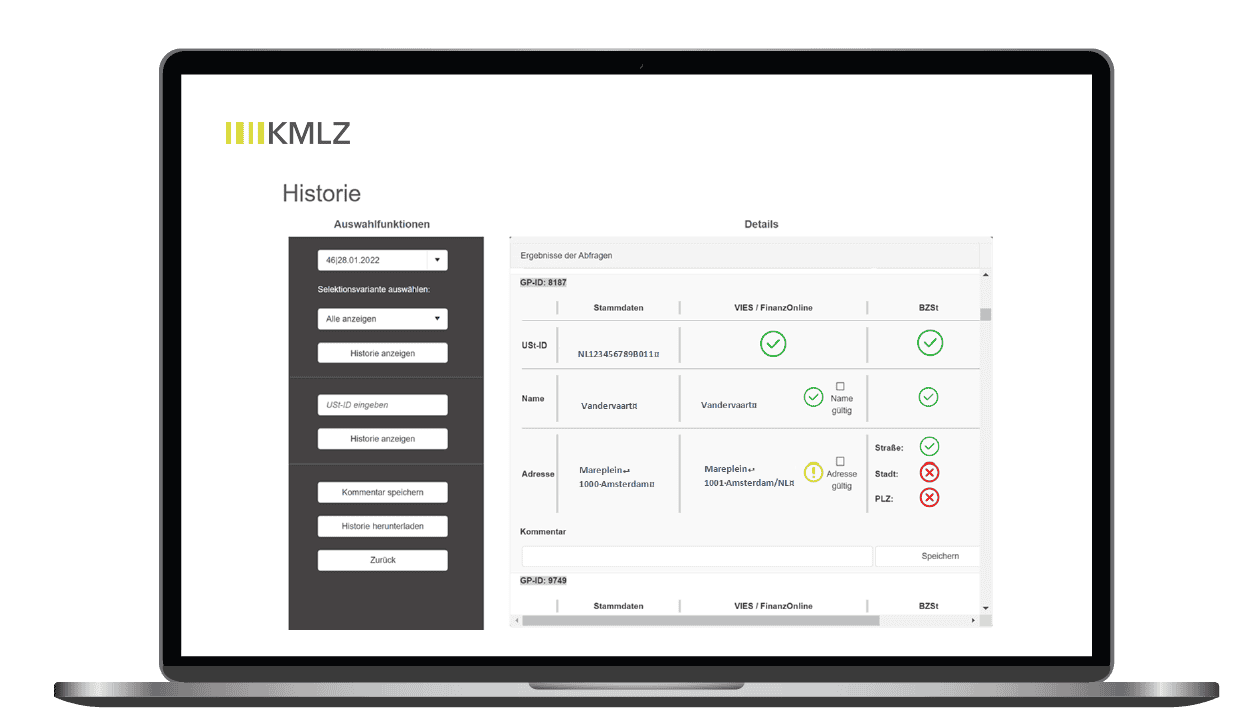
Checks carried out are stored in a history and can be accessed at any time. The history can be filtered, searched and exported. In addition, comments can be added directly to the check record. This results in a fully traceable screening process – a key component for internal approvals, audit trails and audits.
Centralised database:
The sanctions list screening is based on international compliance data sources, which are linked via the “OpenSanctions” database. This ensures that up-to-date, globally relevant sanctions and PEP information is available centrally. On this basis, the Verifier Suite can be used not only in Europe but worldwide to carry out sanctions list checks.
Seamless integration:
The solution can be easily integrated into existing systems and automatically incorporated into existing processes. Extensive process adjustments are not required.



Increased legal certainty: Reduction of liability risks in foreign trade and sanctions law

Rapid decision-making: Immediate initial assessment in the front end

Traceable results: Transparency regarding relevance, name variants, data sources and context

Audit-proof documentation: History, comments and export functions for audit purposes
Integration into business processes: Efficient integration into sales, compliance and specialist departments
FAQ
What is a sanctions list check?
A sanctions list check is a compliance process whereby companies verify whether business partners appear on international sanctions lists. The aim is to prevent breaches of embargo and sanctions regulations.
Why is a sanctions list check required by law?
Companies are obliged to ensure that they do not make economic resources available, either directly or indirectly, to sanctioned individuals or organisations. This is based on EU and international embargo regulations.
Who must carry out sanctions list checks?
All companies with national or international business relationships are affected. The check is particularly relevant for:
- Sales and procurement
- Finance and payment processes
- Logistics and foreign trade
Which business partners must be checked?
In principle, all relevant business partners, in particular customers, suppliers, banks, and logistics and service providers.
How often must a sanctions list check be carried out?
Sanctions lists are continuously updated. Checks must therefore be carried out regularly and on an ad hoc basis, particularly for new business partners and when there are changes to existing data.
Why is a manual sanctions list check not sufficient?
Manual checking processes are prone to errors, time-consuming and not scalable. In view of increasing regulatory requirements, an automated sanctions list check is essential and frees up valuable resources in compliance management.
What does an automated sanctions list check achieve?
An automated sanctions list check enables the rapid and structured screening of large volumes of data, reduces manual effort and ensures consistent results.
How does the sanctions list check work in the Verifier Suite?
The Verifier Suite automatically checks individuals, companies and organisations against international sanctions and compliance databases and provides a well-founded initial assessment right at the front end.
What distinguishes the sanctions list check from simple name matches?
In addition to names, additional parameters such as dates of birth, nationalities, alternative spellings and contextual information are taken into account. This significantly improves the quality of the matches.
What is a PEP check and why is it important?
The PEP check identifies politically exposed persons who pose an increased compliance risk, particularly in relation to money laundering and international business relationships.
Are the results of the sanctions list check transparent?
Yes. The results include information on match probability, name variants, data sources and sanctions programmes, enabling a well-founded assessment.
How is the documentation of the checks ensured?
All checks are documented in an audit-proof manner, including history, comments and export functions. This creates a complete audit trail.
Which data sources are used?
The sanctions list check is based on international compliance data sources via OpenSanctions and provides up-to-date global data centrally.
Can the sanctions list check be integrated into existing systems?
Yes. The solution can be integrated into existing IT systems and automatically incorporated into business processes.
What risks does a sanctions list check reduce?
The sanctions list check reduces criminal liability risks, fines, reputational damage and operational errors in the compliance process.


Automated validation of EU VAT identification numbers and tax numbers from selected third countries via relevant national and international databases.
- ensures VAT exemption for intra-Community supplies
- reduces liability risks
- documents audit results
Verification of the validity of exemption certificates for construction withholding tax.
- avoids liability risks
- carries out verification efficiently, even with high volumes
- documents verification results
Checks on customers and suppliers regarding tax compliance, registered bank accounts or split-payment status.
- provides information on the tax compliance of business partners
- avoids liability risks

