
Verification of the validity of exemption certificates for construction withholding tax

Companies that procure construction services are, as a general rule, obliged to withhold 15 % of the invoice amount as construction withholding tax and pay it to the tax office, unless a valid exemption certificate is available.
In practice, this leads to significant operational and legal challenges: companies should ensure that a valid exemption certificate is available before making any payment and must actively verify it.
A particularly critical issue is the potential liability: if the check is not carried out correctly, or if construction withholding tax is not deducted despite a missing or invalid certificate, the client is directly liable for the tax that has not been paid.
At the same time, putting this into practice is complex: exemption certificates are valid for a limited period, can be revoked and must be updated regularly, whilst, at the same time, large numbers of subcontractors, projects and individual transactions often need to be checked.
Manual testing processes are time-consuming and prone to errors in this environment.
Companies are therefore faced with the challenge of establishing a secure and efficient testing process that functions reliably even when dealing with high volumes.

With its construction withholding tax verification tool, KMLZ offers a specialised solution for the automated verification of exemption certificates.
The tool validates exemption certificates directly within the system and presents the results in a structured format. It clearly shows whether a certificate is available, how long it is valid for and how it should be assessed from a technical perspective.
Individual checks and bulk queries can be carried out efficiently. Where the volume of checks is high, they are automated via structured data imports. This significantly reduces the amount of manual work involved.
All audit processes are stored in an audit trail and can be filtered, analysed or exported at any time. This ensures transparency and enables companies to provide evidence of their audits to internal departments or during tax audits at any time.
By integrating the audit into existing systems and processes, it can be seamlessly incorporated into operational workflows, such as in procurement, accounts payable or project management.


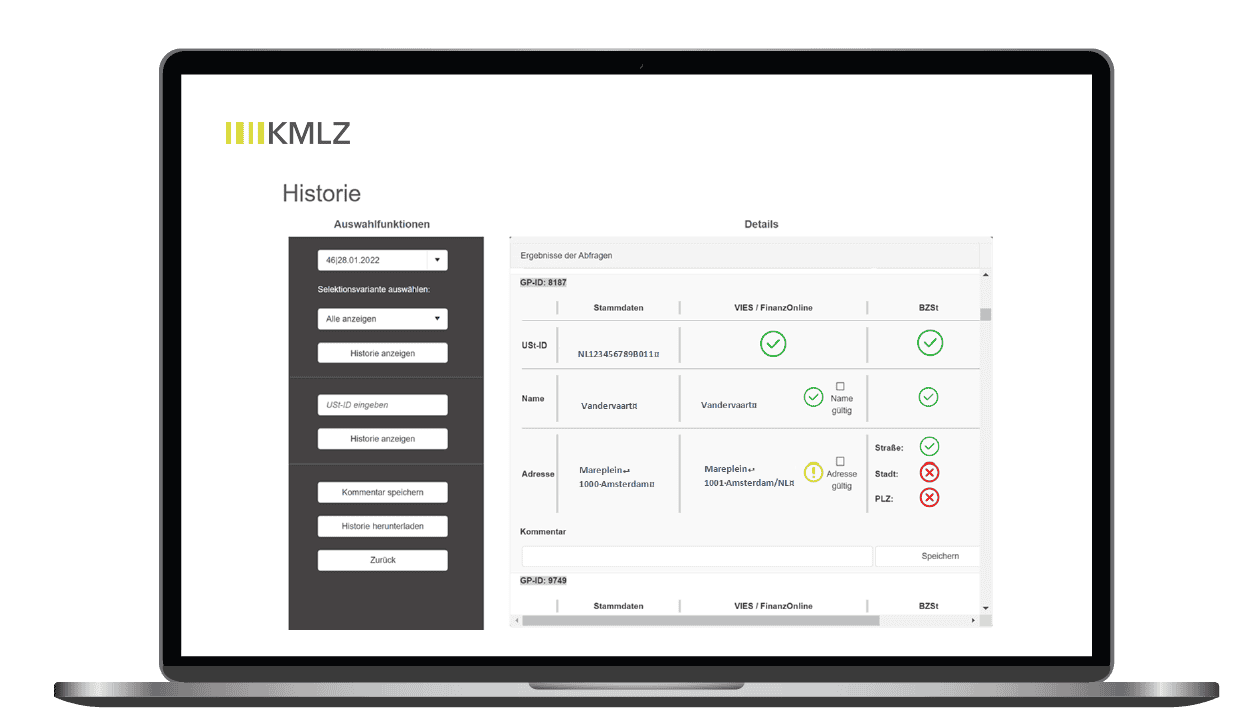

Greater legal certainty: avoiding liability risks through structured and standardised audit processes

Reducing manual effort: automating individual and bulk checks

Quick and clear results: transparent feedback on the validity and status of exemption certificates
Audit-proof documentation: Complete history of all tests

Seamless integration: Integration into existing systems and business processes without any disruption

Improved process quality: reducing errors through standardised data processing
FAQ
How do you check exemption certificates for construction withholding tax?
Certificates of exemption must be checked for validity before each payment is made. The decisive factor is whether, at the time of payment, there is a valid certificate that is clearly linked to the service provider.
When must construction withholding tax be deducted?
Construction withholding tax must be withheld if no valid exemption certificate is available or if the exemption certificate is found to be invalid. In this case, 15 % of the invoice amount must be paid.
Why is it so important to check the exemption certificate in relation to construction withholding tax?
Unless the exemption certificate is properly checked, the client is liable for any construction withholding tax that has not been paid. The check is therefore essential for ensuring compliance with the law.
What counts as a valid exemption certificate for construction withholding tax?
An exemption certificate is only relevant for construction withholding tax if it is valid, has not been revoked and is clearly attributable to the contractor.
How often does the exemption certificate for construction withholding tax need to be checked?
The check must be carried out before each payment. A one-off check is not sufficient, as the status of the exemption certificate may change at any time.
What are the risks of failing to withhold construction withholding tax?
If the construction withholding tax is not deducted correctly, the client is directly liable. Interest may also be payable.
How does the verification tool assist with the verification of exemption certificates?
The tool automates the checking of exemption certificates in relation to construction withholding tax and clearly indicates whether a deduction is required.
Can the audit tool handle large volumes of data for construction withholding tax?
Yes. The tool allows for both individual checks and bulk queries, particularly when dealing with a large number of subcontractors or projects.


Automated validation of EU VAT identification numbers and tax numbers from selected third countries via relevant national and international databases.
- ensures VAT exemption for intra-Community supplies
- reduces liability risks
- documents audit results
Screening of individuals, companies and organisations against international sanctions and compliance databases.
- prevents breaches of embargo and sanctions regulations
- reduces the risk of criminal prosecution and fines
- provides a transparent and traceable assessment of hits
- documents screening results
Checks on customers and suppliers regarding tax compliance, registered bank accounts or split-payment status.
- provides information on the tax compliance of business partners
- avoids liability risks

