
Companies involved in customs-relevant movements of goods (so-called economic operators) must ensure that they observe and comply with customs regulations. This includes all processes and activities that are covered by or related to customs regulations. To ensure compliance with customs regulations, a functioning customs organization is essential. Therefore, It is not surprising that the law requires the existence of an adequate customs organization for granting of customs authorizations (e.g., for customs simplifications or the use of a customs procedure such as inward processing).
Companies with a well-functioning customs organization do not only benefit from the trust placed in them by law and administration. They also benefit in terms of risk management, efficiency, and costs. The organization of customs processes enables the fast, administratively efficient, and duty-optimized handling of shipments, thus avoiding delays at the border. Especially in times of rising import duties and increasing uncertainties in international trade, a strong customs organization can prove to be a valuable asset. From a liability and criminal tax law perspective as well, a sound customs organization is of great importance for companies
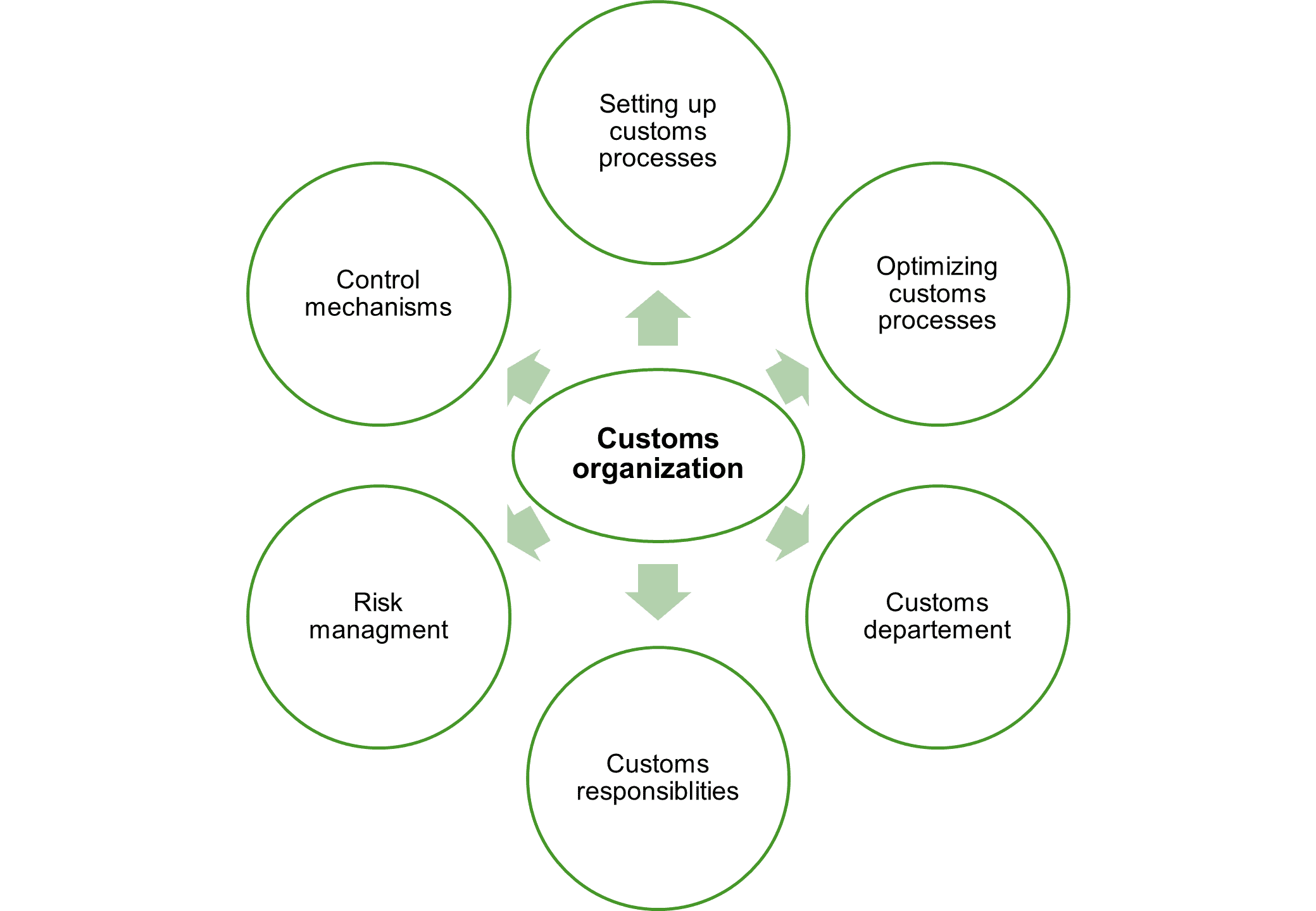
The term 'customs organization' refers to various aspects of customs compliance:
Setting up customs processes
To set up a customs organization within a company, responsibilities, procedures, and control mechanisms must be clearly defined from the outset. This involves establishing a customs department or a customs officer within the company, equipped with the necessary authority to coordinate the company’s customs processes. When setting up a customs organization, the customs-relevant process steps within the company should be clearly defined, identified, and adequately documented. The implementation of customs processes is essential to ensure that the flow of goods can be handled efficiently and in accordance with customs regulations. The setup of a customs organization is particularly associated with the following measures:
Documentation of imports and exports: Creation, review, and archiving of relevant documents (import and export declarations, commercial invoices, freight lists, packing lists, certificates of origin, etc.).
Tariff classification and customs value of goods: Processes for determining the correct customs tariff numbers and customs values for goods being imported and exported.
Process descriptions: Internal company guidelines for the relevant customs processes ensure consistent handling and compliance with legal requirements. They help to ensure smooth workflows even in cases of absence (e.g., vacation or illness).
Optimizing customs processes
Even established customs processes should always be reviewed for potential optimization. Identifying and implementing these opportunities is part of the responsibilities of a good customs organization. Key measures to consider include:
The use of special customs procedures (Article 210 UCC, e.g., customs warehousing, inward and outward processing, or transit procedures).
The use of deferred payment by setting up a dedicated deferment account.
With a dedicated deferment account, companies can improve their liquidity and save costs arising from using a customs service provider’s deferment account.The establishment of central customs departments or customs purpose groups: These approaches allow companies to consolidate their customs expertise and leverage synergies.
Digitalization of customs processes: Customs is subject to continuous international and national digitalization initiatives. Companies should monitor current developments to manage their customs processes digitally and benefit from practical facilitations as well as internal monitoring and evaluation capabilities.
Role of the customs department
In order to successfully implement a structured customs organization, a customs department and/or a customs officer should be established within the company as the coordinating entity. This entity acts as the point of contact for all customs-related matters, both within the company and with authorities and business partners. It is important that this entity is equipped with the necessary powers to effectively manage customs processes and take the required actions.
The key responsibilities of the customs department or customs officer include:
Reviewing customs-relevant documents (e.g., certificates of origin, commercial invoices) and archiving them.
Managing and supervising the services of external service providers (e.g., entering into service contracts, reviewing export declarations and import duty assessments).
Monitoring deadlines.
Tariff classification and determination of the customs origin of goods.
Determining the applicable customs value.
Applying for and managing customs authorizations.
Communication with customs authorities.
As a coordinating entity, the customs department works closely with other departments within the company, such as purchasing, sales, production, and the tax department. As the point of contact for customs-related issues, the customs department and/or customs officer should be involved in their processes.
Risks of inadequate customs organization
An inadequate customs organization can have far-reaching consequences for the company. These consequences are not limited to economic or customs-related issues but may also include liability and tax criminal law consequences. For this reason, companies should recognize and make use of the special importance of a well-structured customs organization.
The risks associated with an insufficient customs organization include, among others:
Revocation of customs authorizations (e.g., AEO) due to customs violations resulting from a lack of tax and customs reliability.
Delays in cross-border shipments and disruptions to business operations.
Retroactive collection of import duties that can no longer be passed on.
(Unlimited) tax liability of the persons responsible under Sections 69 et seq. of the German Fiscal Code (AO) with personal assets.
Consequences under criminal tax law: Initiation of administrative or criminal tax proceedings due to the evasion of import duties.
Consequences under commercial law: Entries in the central trade register.
Possible blacklisting, including exclusion from participation in public tenders.
Customs responsibilities
The legal representatives (mainly executive bodies) of the company are primarily responsible for compliance with customs regulations (cf. section 34 para. 1 sentence 1 of the German Fiscal Code (AO)).
According to the principle of joint responsibility, all legal representatives are equally responsible for fulfilling these duties.
However, the legal representatives have the option to delegate their tax and customs obligations. They can divide responsibilities among themselves based on competence (so-called horizontal delegation of duties). In addition, they can also delegate their customs responsibilities to subordinate levels (so-called vertical delegation of duties). In this case, a customs officer may be appointed to take on the operational responsibility for compliance with customs regulations and act as the interface between the company and customs authorities. For companies regularly exporting goods subject to special licensing requirements, such as dual-use goods, appointing an export compliance officer may also be considered. This person is responsible for ensuring compliance with export control regulations and applying for export licenses from the Federal Office for Economic Affairs and Export Control (BAFA).
However, the delegation of duties does not completely absolve the legal representatives from their responsibilities. Their duties change from direct fulfilment obligations to selection and supervision duties, according to Section 35 of the German Fiscal Code (AO). It is essential to ensure that those to whom duties are delegated have sufficient knowledge to carry out their tasks and regularly attend trainings.
The delegation of tasks to external customs service providers (ranging from the individual transfer of import clearances to the transfer of the entire customs organization in the context of outsourcing) is also possible. This includes, in particular, customs agents who may represent the company directly or indirectly vis-à-vis the customs authorities, Article 18 UCC. Since errors and violations by the customs service provider are attributed to the company, it is important to carefully select the service provider and maintain a close, trustworthy collaboration with a reliable customs service provider. Additionally, regular monitoring measures are necessary.
Building a comprehensive documentation system is indispensable in all respects.
Risk Management using a Customs Compliance System
Integrating the customs organization into the Tax Compliance Management System (Tax CMS) can ensure comprehensive compliance within the company.
This enables both tax obligations and customs requirements to be coordinated and effectively managed. Additionally, there is the possibility of establishing a separate customs compliance system for the customs organization.
Such a compliance system for customs purposes can not only contribute to internal optimization but also simplify cooperation with customs authorities. For instance, a customs audit can be handled more quickly and under more favourable conditions with a customs compliance system in place. In practice, tax authorities consider such a system is an indicator against the presence of intent or negligence in the case of tax evasion (AEAO to Section 153 AO, paragraph 2.6, sentence 6).
The requirements for an effective compliance system are not clearly defined by either the legislator or the tax authorities. However, certain minimum requirements have been established in practice for a customs compliance system:
Documentation of the system’s control function (e.g., by means of a "customs manual").
Identification and definition of the customs processes within the company.
Documentation of workflows for customs-relevant processes (e.g., through directives, work and organizational instructions, checklists, etc.).
Continuous identification and assessment of risks through regular controls.
Comprehensive documentation of all performed controls
The customs compliance system can be structured as follows:

Control Mechanisms
To ensure compliance with customs regulations, the implementation of effective control mechanisms within the company is crucial. Possible control mechanisms include:
Dual control principle during processes.
Systematic evaluation of data to identify specific circumstances in individual cases (e.g., verification and random sample checks).
Organizational and technical controls through the use of IT (e.g., automated plausibility checks).
Event-based investigations.
In order to successfully carry out these controls, responsibilities and the monitoring process should be defined. Reports on the results of the monitoring measures should be generated and reviewed by the responsible department.
As part of the digitalization of customs processes, companies should leverage IT-supported audit and monitoring systems. Tax and customs software applications allow companies to systematically review, document, monitor, and manage their customs processes. These applications offer companies, among other things, the following possibilities:
Digital mapping of customs processes and responsibilities.
Automated control mechanisms (e.g., deadlines, tariff classification, authorizations).
Interfaces to ERP systems and customs service providers.
Audit-proof documentation and reporting.
Contact


